The Golden Hour
Tech & Theme Challenge
Objective
Have you ever taken a photo outside at noon and wondered why everyone had dark, raccoon-like shadows under their eyes and the whole scene looked harsh and washed out? Then, a few hours later right before sunset, you stood in the exact same spot and suddenly your backyard looked like a scene from a movie?
This week we’re exploring the Golden Hour, which takes place for roughly the first hour after sunrise and the last hour before sunset. Because the sun is sitting super low on the horizon, its light has to travel through a much thicker slice of the Earth’s atmosphere to reach you. That extra atmosphere acts like a filter, scattering away the harsh, cool blue wavelengths and leaving behind warm, dreamy reds, oranges, and yellows.
Our goal this week is to use the unique color temperature, directional light, and long shadows of the Golden Hour not just to illuminate a scene, but to transform the mood, texture, and story of your subjects.
Warm-Up Prompts
To warm up our thinking, consider these prompts. You don’t have to answer them all, but read them over and try to find the one that sparks something in your brain.
Remembering: In your own words, when does the Golden Hour happen, and what are the three main ways the light is different from midday sun?
Understanding: Why does the sun look so much warmer and softer right before sunset compared to midday? What is the sky actually doing to the light?
Applying: Without a camera, hold a flashlight (or your phone light) directly above a small object on your desk, like a mug or an action figure. Slowly lower the light until it’s shining sideways right across the surface of the desk. What happens to the shadow and the texture of the object?
Analyzing: Look at the photos in the Inspiration Gallery. Where is the sun hiding in each shot? Is it behind the subject, off to the side, or behind the photographer? How does that angle change the mood?
Evaluating: “Golden Hour makes it way too easy to take a pretty picture! It’s basically a cheat code that hides bad composition.” Do you agree or disagree, and why?
Guide
Beat the clock! The Golden Hour isn’t actually a full sixty minutes. Depending on where you live and the season, the best light might only last 20 minutes and it changes fast. Check a weather app to see when sunset (or sunrise) happens, and get outside at least 15 minutes early so you aren’t scrambling while the light disappears.
Study the Light’s Paintbrush. Find a stationary subject (a friend, a dog, a tree, a cool car) and walk in a complete circle around it while taking photos:
Front Lighting (Sun behind your back): Notice how flat, warm, and glowing your subject looks. Notice your own giant shadow stretching into the frame!
Side Lighting (Sun at your shoulder): Watch how the low angle carves out every tiny bump, blade of grass, or brick texture with long, dramatic shadows.
Backlighting (Pointing your camera toward the sun): Look for rim light giving your subject a glow at the edges.
Outsmart your camera’s Auto White Balance (AWB). Sometimes phones and cameras see all that gorgeous orange light and automatically try to “fix” it by turning your photo icy blue. If your camera has White Balance presets, switch it from Auto to a preset to lock in the golden tones. Explore how your camera’s presets each interact with the Golden Hour’s distinct lighting.
Hunt for Lens Flare. Normally we try to keep stray light out of our lenses, but during Golden Hour, letting the sun peek just around the edge of a tree trunk, building, or person’s shoulder can create amazing hazy rings and starbursts across your frame. Remember to experiment with different Focal Lengths and Apertures to see how they distort the light.
Process
Decide on your personal goal. Do you want to capture a dramatic, pitch-black silhouette against a glowing sky? Use rim light to make a normal object look magical? Or use thirty-foot-long shadows as the leading lines of your composition?
Challenge yourself to try at least one new idea from the guide while you shoot. Let the rapidly changing light push you to move fast and see things differently.
Prepare to take photos:
Look up today’s exact sunrise or sunset time and plan when you’ll step outside.
Pick a spot where buildings or dense trees won’t block the low horizon before the sun even finishes setting.
Keep an eye on your ISO and shutter speed. As the sun dips down, the world gets dark way faster than your eyes realize, and your camera might start blurring motion if you aren’t paying attention!
Capture way more photos than you think you need. Experiment. Play. The light changes every single minute, so a shot that looks okay at 5:15 PM might be breathtaking at 5:25 PM.
Make every photo unique. Don’t just take six pictures of a pretty sky! Remember that Golden Hour is about what the light touches, not just the sunset itself. Shoot through tall grass, catch light bouncing off a window, or get down low to the ground.
Pick four photos to share with our classroom.
Try to provide the f-stop, shutter speed, and ISO. If you changed your White Balance or exposure compensation, tell us about that too!
Inspiration Gallery
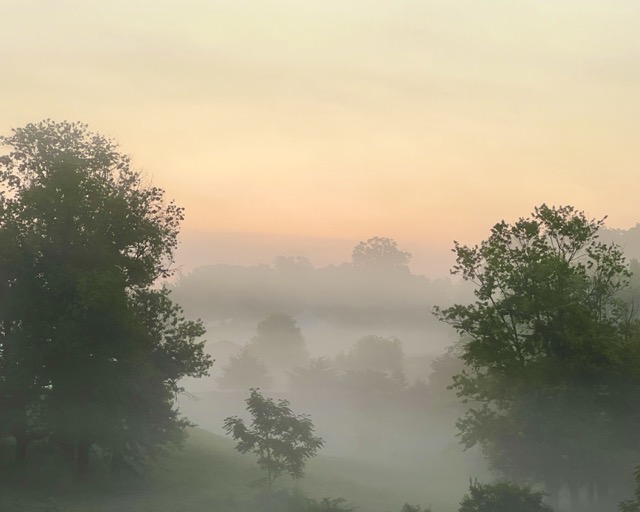
Take a look at how these photos capture different moments around sunrise and sunset. In some, the camera stares right into the low sun, catching a rainbow lens flare across the fuzzy seeds of a dandelion or a sharp golden starburst peeking through a tangle of dark, bare tree trunks. In others, the light is softer and more mysterious, like warm sunrise gold melting into layers of morning fog in a wooded valley, a glowing ribbon of sunset reflecting across calm water, or even the warm flame of a garden lantern carving out leaves against a cool evening sky. As you look through them, try to figure out where the light is coming from and how the photographer used it to shape the mood.
![256]] 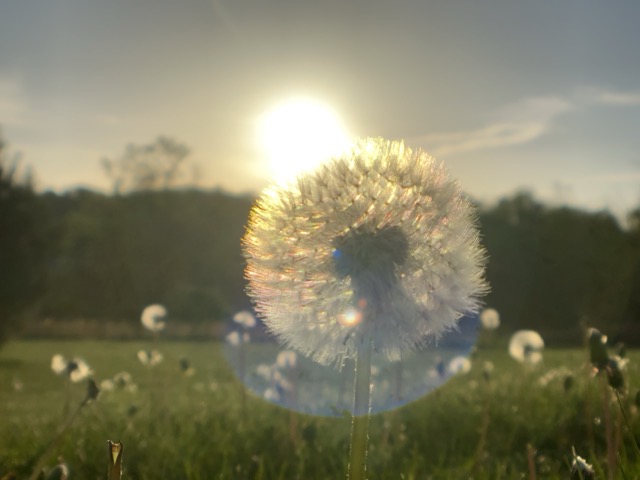
![256]] 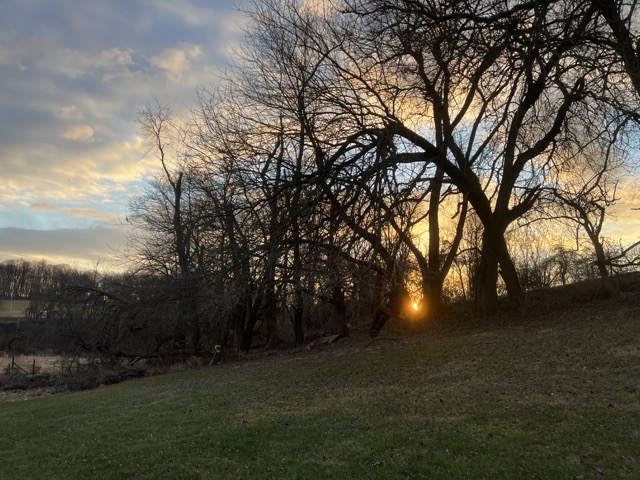
![256]] 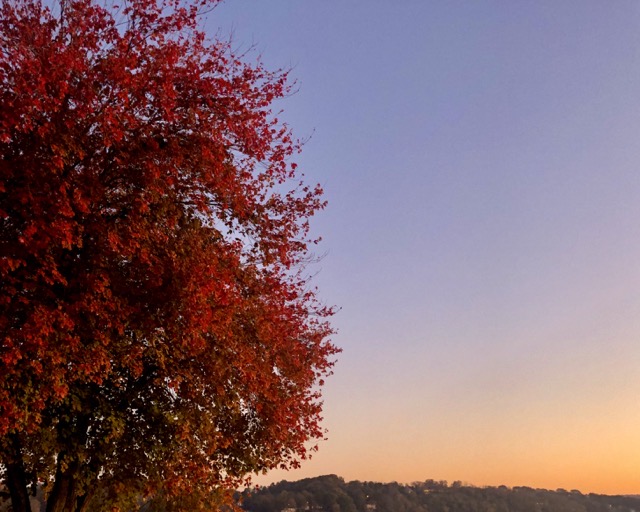
Guiding Questions
What happens when you hide the sun?
Look at the dandelion photo and the shot of the bare trees on the hill. In both, the photographer placed a subject right in front of the blinding sun. How does blocking the sun just a little bit transform the edges of the dandelion fluff or the gaps between the tree branches?How can out-of-focus light tell the story?
In the close-up of the white flower petal, the flower itself is actually in cool, soft shade, while a bright patch of golden light glows in the bottom corner. How does using a blurry background (bokeh) turn small pockets of sunset light into part of your composition?Who wins the exposure battle: the sky or the subject?
When shooting toward a sunset, cameras struggle to capture both the bright sky and the dark foreground. In the tree-line and lakeshore photos, the land turns nearly pitch-black so we can see the rich colors of the sky and water. When should you let your foreground turn into a dark silhouette, and when should you brighten it up?How do weather and water change the light?
Compare the misty valley photo with the sunset over the water. Fog scatters golden light into soft, dreamy layers that hide the background, while water acts like a mirror, turning the sunlight into a bright leading line. What surfaces or weather around your neighborhood can bounce or soften the sun?Can warm and cool colors work together?
Look at the red autumn tree against the twilight sky, or the glowing orange lantern surrounded by deep blue-green evening leaves. How does having cool blues and purples in the frame actually make the warm oranges and golds pop even more?What happened five minutes later?
As the sun drops below the horizon, Golden Hour fades into Blue Hour, when the sky turns deep cobalt and artificial lights (like porch lamps or lanterns) take over. How do the mood and shadows of your scene change from the beginning of sunset to the very end?
Self-Assessment Checklist & Rubric
To get the most out of photography club, ask yourself these questions and aim for High Quality (3) in all of your photos. Remember that it’s ok to share Low Quality photos, especially if you have questions about how to improve them.
▢ Posted multiple photos.
▢ Commented on other’s photos.
▢ Participated in discussion.
| High Quality (3) | Mediocre Quality (2) | Low Quality (1) | |
|---|---|---|---|
| Concept / Theme | The photo clearly captures the warm, directional qualities of the Golden Hour and uses the light to transform the mood and story of the scene. | The photo was clearly taken near sunrise or sunset, but the golden light feels incidental rather than the star of the image. | The lighting is flat, harsh, or unrelated to the Golden Hour theme, or it is just a snapshot of the sky with no clear subject. |
| General Composition | Long shadows, rim light, silhouettes, or warm tones are used deliberately as compositional tools to guide the viewer’s eye through the frame. | The photo attempts to use Golden Hour light in the composition, but shadow placement or framing feels somewhat accidental. | The photo shows little control over framing, subject placement, or how light and shadow interact in the frame. |
| Direction & Exposure of Light | The photographer deliberately controlled the angle of the sun (backlighting, side lighting, flare) and balanced the exposure intentionally for either highlights or shadows. | The subject is lit by the low sun, but the exposure is muddled (e.g., accidentally blown-out sky or unintentionally murky shadows). | There is no awareness of light direction or exposure control; the camera’s auto settings struggled with the contrast. |
| Originality | The photographer combined their interpretation of the theme with deliberate lighting and angle choices to present a captivating, unique image. | The photographer attempted to find a unique perspective on Golden Hour light, even if the result isn’t perfect. | The photo is dull or derivative (e.g., a generic snapshot without thought given to the foreground or light interaction). |